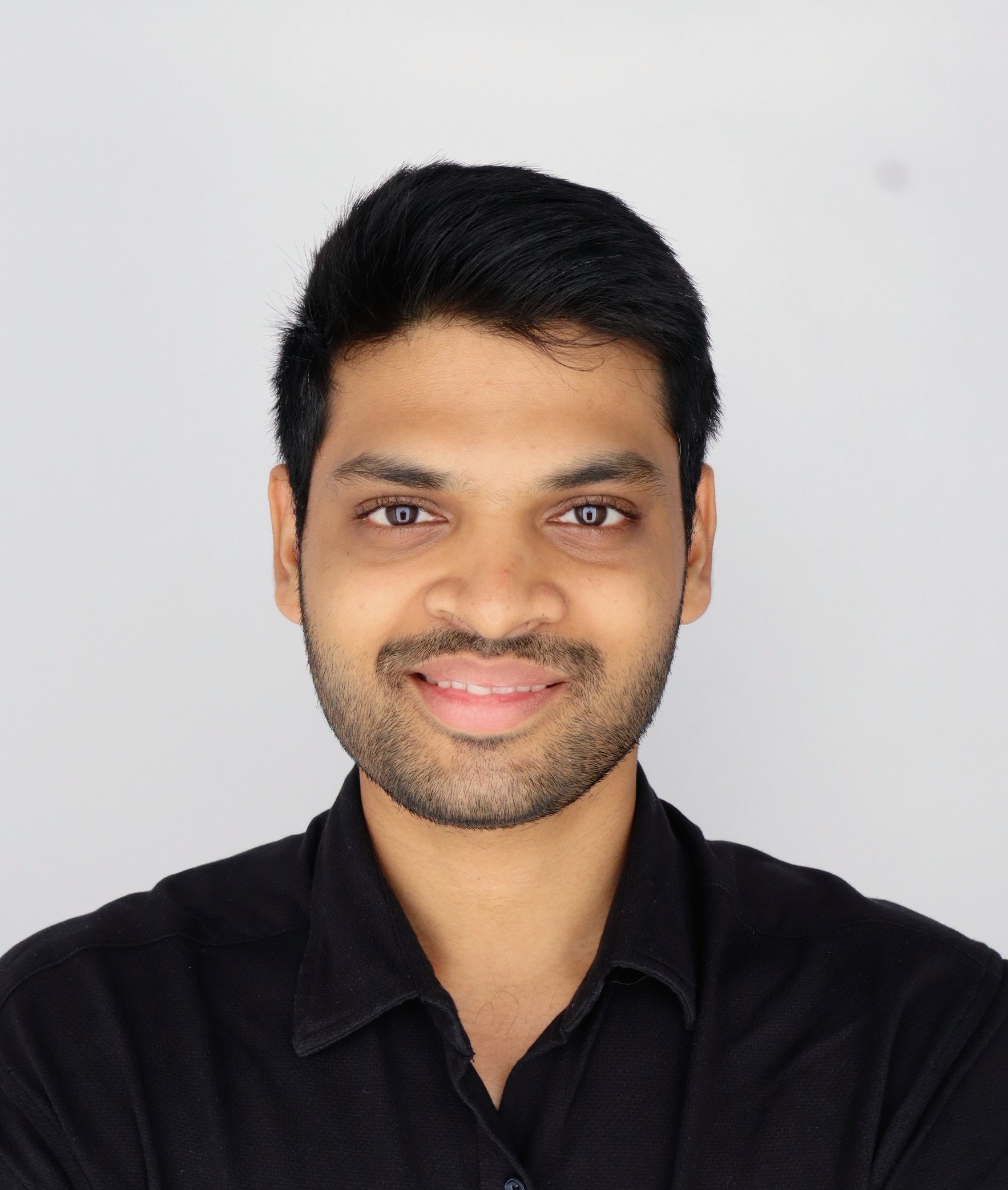
Saratchandra Patnaik
Backend, Full-Stack & AI Systems Engineer
I build AI-native backend systems, RAG applications, agentic workflows, and cloud-native infrastructure using Python, Go, FastAPI, React, Kubernetes, and AWS.
At Coupa Software I build RAG-driven procurement automation, Go microservices, and containerized generative AI deployments for enterprise contract analysis and supply chain forecasting.
At Amagi Media Labs I owned reliability for 15+ microservices on a global SaaS platform serving broadcasters and OTT providers across 40+ countries — shipping async Python/FastAPI services, LLM-powered observability tooling, and GitOps infrastructure on AWS EKS. MS CS from Arizona State University.
Experience
Software Engineer
Coupa Software · United States
Enterprise SaaS · Business spend management — procurement, contracts, suppliers & supply chain
Python · FastAPI · Go · PostgreSQL · AWS SQS · Docker · Kubernetes · MLflow · RAG
Build AI-native backend systems for enterprise procurement — RAG-based contract analysis workflows, Go microservices with asynchronous messaging, and containerized generative AI deployments that turn slow manual business processes into automated ones.
- ▹Architected intelligent procurement automation workflows with Python, FastAPI, and Retrieval-Augmented Generation, streamlining enterprise contract analysis to reduce manual legal review time by 40%.
- ▹Engineered backend microservices and asynchronous messaging pipelines with Go, PostgreSQL, and AWS SQS, decoupling monolithic vendor integration modules to keep platform reliability uninterrupted.
- ▹Deployed scalable generative AI models and continuous delivery loops using Docker, Kubernetes, and MLflow, accelerating predictive supply chain forecasting features that recaptured $1.2M in operational overhead.
Intelligent Procurement Automation & Contract Analysis
Problem: Enterprise contract review is manual and slow. Legal and procurement teams read documents end to end, check clauses, compare terms, and flag risk by hand — which does not scale across hundreds of vendors and contracts.
Approach: Designed FastAPI services that wrap a RAG pipeline: extract document text, chunk it, embed and index the chunks, retrieve the passages relevant to a given question, and ground the LLM response in that retrieved context rather than letting the model answer unaided. Added response validation so unreliable outputs never reach reviewers.
Result: Cut manual legal review time by 40%. In parallel, moved vendor integration off a monolithic path onto Go microservices communicating through AWS SQS, so validation, persistence, and downstream processing no longer block one another.
Software Engineer
Amagi Media Labs · Bengaluru, India
Global SaaS · Cloud-native AI platform for media & entertainment · 40+ countries
AWS EKS · Python · FastAPI · Kubernetes · Docker · ArgoCD · Terraform · Linux
Built and operated backend services and AI-powered pipelines on a global SaaS platform for broadcast and OTT media delivery — shipping async Python/FastAPI microservices, LLM-driven observability tooling, ML captioning services, and GitOps-based infrastructure across 15+ production services on AWS EKS.
- ▹Reduced media processing latency by 93.75% — from 8 minutes to 30 seconds — by rewriting the frame and metadata pipeline as an async Python/FastAPI service with CV model integration.
- ▹Built an AI-powered log analysis service that parsed raw server logs and surfaced root causes automatically, cutting manual debugging time by 60%.
- ▹Owned REST API design, versioning, and sprint-based rollout across 15+ microservices on AWS EKS, keeping contracts backward-compatible as services evolved.
- ▹Increased deployment frequency by 30% across 15+ microservices by migrating to ArgoCD GitOps on AWS EKS, maintaining 99.9% rollout stability.
- ▹Hardened the Kubernetes platform with Network Policies for microservice isolation and Terraform-based IP whitelisting for network perimeter security.
- ▹Led the first production rollout of native speech-to-text captioning services (Capsequo, Akashvani), owning provisioning, feature flags, validation, and team enablement.
- ▹Resolved a peak-hour live broadcast outage in 40 minutes by diagnosing primary-feed audio silence and coordinating a controlled failover to the healthy secondary stream.
AI-Powered Observability & RCA Automation
Problem: RCA was a bottleneck — engineers repeatedly inspected the same logs to diagnose recurring failures, with each incident costing hours of manual investigation.
Solution: Built an AI-powered observability pipeline that ingests server logs into LLMs for automated semantic pattern analysis, surfacing likely failure causes without manual inspection.
Impact: Reduced manual debugging time by 60%. Also deployed the Capsequo ML captioning pipeline, cutting video stream processing latency by 36%.
Media Workflow Latency Optimization — 8 Minutes to 30 Seconds
Problem: Cue-point generation from video content was a bottleneck. The existing pipeline used simple frame-transition logic (pauses, cuts) rather than computer vision models. Long-form videos (~1 hour) took ~8 minutes per file to process, creating downstream delays across the media pipeline.
Approach: Built an asynchronous Python/FastAPI pipeline that aligned frame analysis and metadata processing into a unified flow. Moved from basic cut detection toward CV-model-based frame understanding. Eliminated unnecessary waiting between pipeline stages to improve throughput for long video assets.
Result: Reduced per-video media workflow latency by 93.75% — from 8 minutes to 30 seconds. Reduced reliance on manually supplied customer cue sheets and accelerated all downstream video operations that depended on cue-point output.
Associate Software Engineer
Hexaware Technologies · India
Global IT services & consulting · Enterprise applications and digital transformation
Django · React · REST APIs · MySQL · MongoDB · Jenkins · Git · Terraform
- ▹Full-Stack Development: Built resilient administrative web applications with Django, RESTful APIs, and React, modernizing legacy enterprise client portals — increased daily active user adoption by 22%.
- ▹Database Optimization: Optimized heavy-read relational queries and indexing strategies across MySQL and MongoDB, removing the server latency constraints behind slow page loads for a more responsive end-user experience.
- ▹CI/CD Automation: Orchestrated build, test, and deployment pipelines with Jenkins, Git, and Terraform — prevented critical production regressions and accelerated feature time-to-market by 3 weeks.
Education
Master of Science in Computer Science
Arizona State University · Tempe, AZ
Computer Science
Bachelor of Engineering in Computer Science
Christ University School of Engineering · Bengaluru, India
Computer Science & Engineering
Skills
AI Engineering
Machine Learning
Backend Engineering
Cloud & Infrastructure
Reliability & DevOps
Data & Storage
Systems Programming
Languages
Practices & Tools
Projects
Personal AI Agent — Multimodal RAG System
Full-stack AI assistant built with React, FastAPI, ChromaDB, and OpenAI/Anthropic APIs for resume optimization, ATS workflows, and vehicle diagnostics.
Deep Research Agent
Autonomous multi-agent research system with n8n orchestration, SQLite episodic memory, and ChromaDB long-term retrieval for job matching and complex research synthesis.
Go MCP Gateway
Secure Go-based MCP gateway that exposes backend tools to AI agents through authenticated endpoints with OIDC/JWKS, Prometheus metrics, and Dockerized deployment.
Multi-Tenant Event Management Platform
Full-stack SaaS platform for isolated multi-tenant event booking with RBAC, PostgreSQL row-locking, recursive CTEs, and 61 REST APIs.
AWS IoT Greengrass Edge Face Recognition
Edge AI pipeline using AWS IoT Greengrass, MQTT, Lambda, MTCNN, and FaceNet to perform distributed face recognition across cloud and edge components.
CUDA GPU Accelerated Image Processing
GPU-accelerated Gaussian filtering implementation using CUDA/PyCUDA shared-memory tiling, benchmarking speedup and image quality against CPU baselines.
Multithreaded UDP Packet Processing Server
High-throughput UDP server using C++ worker threads, shared queues, packet validation, and reorder buffering for stable concurrent packet processing.
NYC Taxi Streaming Data Pipeline
Real-time NYC taxi streaming pipeline using Kafka, Python, Neo4j, Docker, and Kubernetes/Minikube to model trip relationships as a graph for live querying.